
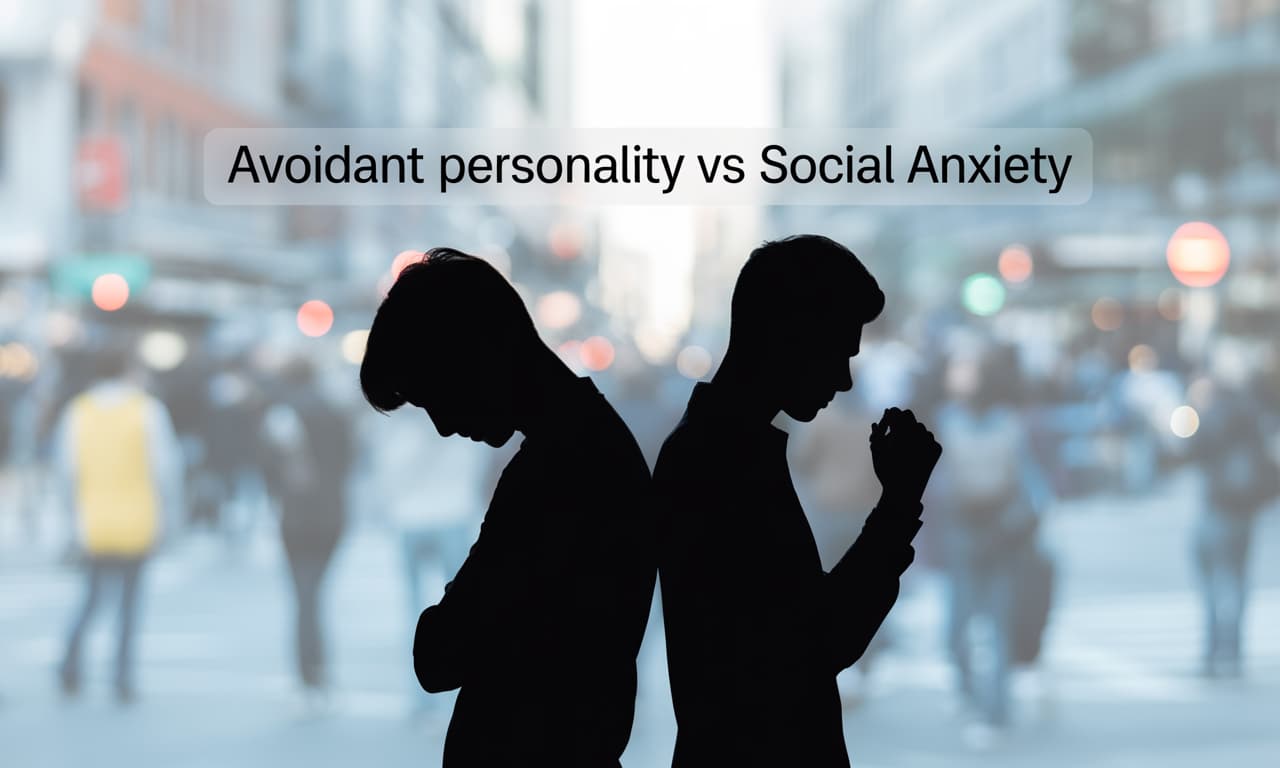
There are many social situations people encounter in life that they have to navigate through, for example, worrying about a presentation, along with being part of a gathering. One could think of these examples as feeling the same, but if these feelings are pronounced, then sad (social anxiety disorder) or AvPD (avoidant personality disorder) might be in your near future.
At first glance, these two conditions may appear to be almost the same. In both scenarios, there is a phobia of sociocultural interaction and the avoidance of active participation. The difference becomes clearer in relation to the sociological theories on the causes, signs, severity, and treatment approaches used for each case of acute disorder.
The consequences of social anxiety disorder are more extensive in that the sufferer cannot function socially on greater levels, while avoidant personality disorder focuses on a singular social anxiety, which is quite specific. Knowing this difference enables one to ensure that the focused intervention helps them understand themselves better and get the right tools needed for healing.
Common Ground: Where They Overlap
The main feature both AvPD and SAD share is the fear of being judged. People with either condition are withdrawn, shy, and display an acute sense of social awkwardness along with overwhelming feelings of inferiority. In fact, meeting new people and talking to them are strenuous tasks.
Both disorders heavily rely on avoidance. This includes silence during conversations, total withdrawal from social contact, or attending events without consistent attendance (RSVP’ing ‘yes’ but failing to show up). In academic and social scenarios, these individuals attempt to avoid shame, rejection, or embarrassment.
Emotionally, people in both groups feel detached due to a lack of social self-actualization. Though they deeply desire relationships, they struggle with the reality of actually wanting such relationships.
An outside observer might expect to see a single cohesive set of behaviors. The difference in thinking and degree of dysfunction is where the real differences become apparent.
What Is Social Anxiety Disorder?
Social Anxiety Disorder refers to an enduring phobia of social interaction and the imminent scrutiny. Sufferers of this disorder tend to shy away from social events and activities, develop secondary agoraphobia, or become fidgety in socially restricted places.
This condition seems to be linked with “us,” and it is also showing via multiple physical symptoms like rapid heartbeats, oversweating, turning red, and stomach pain. These can be symptoms of SAD.
For SAD, the fears are centered around certain activities such as meeting people, going to interviews, and public speaking. These activities may be challenging for some people, while they easily interact with family and close friends. Moreover, some people also worry about being the center of attention or having to eat in front of others.
Often, this form of social anxiety disorder develops in adolescence, and individuals may experience fluctuations in its intensity over time. Typically, people who have this type of social anxiety remain socially active. With some help, they can perform well in most areas of their lives. While the condition may feel distressing, it can be managed.
Most often, the root cause of social anxiety lies in self-criticism combined with negative introspection and evaluation, rather than stemming from severe internalized ideals of deep self-defectiveness.
Avoidant Personality Disorder
Avoidant personality disorder is considered more profound and pervasive than social anxiety disorder. This type of disorder has a more severe impact on the individual’s self-concept, which includes their relation to other people and the world. For this reason, it is categorized as a personality disorder, bearing the code AvPD.
Individuals suffering from AvPD tend to view themselves as socially incompetent, unappealing, or inferior. This affects their entire life, not just particular moments. It leads a person with AvPD to avoid social interactions, not only to escape judgment and ridicule, but also because they feel devoid of the most fundamental human value.
In the case of AvPD, the scope of avoidance is much broader, encompassing one’s self-image, relationships, career, and even interests. There may be some hidden ways to reach some form of happiness or relationship, but these routes are very rarely traveled because the desire to hope is overwhelmed by the fear of rejection.
AvPD is socially identifiable and chronologically distinct because social anxiety tends to arise later in life. It develops as a result of a perceived inadequacy that is much more deeply rooted. This belief is quite rigid and extremely difficult to shift.

What Distinguishes the Two Disorders
Practitioners zero in on the most prominent differences and apply them while framing SAD in conjunction with AvPD, as both similarities remain fundamental to further development into one another.
Scope of Avoidance
In social anxiety disorder, or SAD, avoidance behavior is more work-centered and applies to any position that deals with interfacing with the public. Most people appear to be able to form and maintain relationships, but rounded-off interactions and socializing induce a modicum of strain.
In AvPD, or avoidant personality disorder, the withdrawal syndrome expands to nearly all areas of functioning. Forming intimate bonds is viewed as very perilous. Even trivial exchanges can appear dangerous. There is a more chronic and global pattern to the withdrawal.
Self Examination
Individuals suffering from SAD tend to believe that their fears are out of touch with reality and want to do something about them. Such individuals tend to have fair self-esteem but only in private settings.
On the other hand, the individuals suffering from AvPD tend to view their condition as a deep characterological defect along with an absence of self. These emotions drive the relentless fear of abandonment and seclusion. Individuals struggling with AvPD have an underdeveloped self-image and feel a deficit of affection and esteem, which, paradoxically, inflates their fears.
Mental Disorders
SAD is an anxiety disorder and is classified as such. It is more situational in nature or linked to specific actions and behaviors that are relatively fleeting.
AvPD, or avoidant personality disorder, is classified as a personality disorder. This implies it is associated with an organized pattern of thinking, feeling, and relating over an extended period of time.
With AvPD, there is not just a fear. Rather, it is a more complex worldview that is self-rejecting and anticipatory of exclusion.
Response to Treatment
Both disorders can be treated by professionals, but the results may differ. SAD, for one, seems to respond well to cognitive behavioral therapy (CBT), exposure therapy, and some medications.
Treating AvPD would necessitate a high-trust relationship prior to healing identity-level work, which may take longer to resolve than other conditions. In these cases, progress often takes longer because the fear is more pervasive and profound.
Can Someone Have Both?
This is a fairly common situation, and the answer is yes, it is possible. Many individuals diagnosed with AvPD also qualify for a diagnosis of social anxiety disorder (SAD). What makes this distinct is the fact that the presence of AvPD connotes a more chronic and entrenched form of social avoidance with greater emotional distress and functional impairment.
Some therapists consider AvPD to be a more severe form of SAD, which remains quite a debate. Some practitioners think both issues have different triggers from the same set of feelings.
The most critical aspect is accurately grasping the complexities of the disorder. Both SAD and AvPD present their own difficulties; however, the emotional distress that creates these challenges is burdensome and requires compassionate support.
Assessment and Professional Evaluation
For this reason, self-diagnosis is not advisable since it might lead to an inaccurate understanding of the situation. To put it simply, therapists and mental health professionals specialize in examining symptoms and differentiating conditions such as depression or trauma-centered disorders.
Evaluation usually includes multiple interviews, various questionnaires, and a complete assessment of the individual’s life. The objectives include examining the duration of symptoms, functioning in day-to-day activities, and identifying relevant core beliefs and causal factors.
An accurate diagnosis paired with understanding fosters comfort and improves the healing journey.
Recommended Treatment Approaches
Both social anxiety disorder and avoidant personality disorder can be treated, noting that some more complex or acute cases may need a different, tailored approach.
For Social Anxiety Disorder Treatments:
Cognitive behavioral therapy effectively treats social anxiety disorder because it addresses the rigid thought patterns people struggle with. CBT helps individuals confront negative self-views and face feared situations gradually. Another critical part of CBT is exposure therapy, which allows individuals to confront their fears step by step within a controlled environment, helping reduce fear over time.
Adjunct medications, including SSRIs and other social anxiety medications, can be prescribed alongside therapy to alleviate symptoms and enhance therapy’s effectiveness. Other therapies and support groups that focus on mindfulness and social skills also help improve self-esteem and confidence.
For Avoidant Personality Disorder:
Focusing on interpersonal and temporal dimensions in treatment is the most important. Due to the deep levels of self-doubt associated with this disorder, either relation-focused or self-focused psychodynamic and schema therapies can help participants understand the origins of their self-doubt and learn to form healthy relationships. Building trust with the therapist is crucial, as there is often fearful judgment surrounding therapy.
Combining CBT and AvPD works very well and benefits from longer-term therapies that focus on identity and deep emotional core needs.
For people with Avoidant Personality Disorder (AvPD), therapy demands a leap of faith because most people with the disorder tend to avoid seeking help due to the fear of rejection.

The Importance of Kindness in Recovery
Healing oneself fully begins with self-compassion. This applies whether you are coping with social anxiety or an avoidant personality disorder. Rather than considering these reactions as weaknesses, it is much more helpful to consider them the outcome of fear, shame, and trauma.
Support can help someone learn how to manage discomfort, engage with other people, and combat the self-defeating beliefs that keep them stuck. The process may take time, but reaching milestones, no matter how small, enables one to explore new possibilities and experience newfound freedom.
Close friends or family members are equally important. Empathy goes a long way in helping someone who is down or feeling blue, it is far better than harsh words or judgment. Helping someone overcome the anxiety that exacerbates isolation is invaluable.
Social anxiety disorder and avoidant personality disorder overlap in the context of socialization but differ in many ways. Social anxiety is often limited to specific situations, centered around a particular form of engagement, often, but not exclusively, a performance. Conversely, AvPD infiltrates nearly all dimensions of an individual’s existence with a pervasive fog of fear and acutely low self-esteem.
These elements greatly affect social life, which is critical for precise diagnosis and intervention strategy. Advanced meaningful healing enables individuals to safely confront negative self-perceptions, take back their lives, and boost their confidence and life satisfaction.
Avoiding connection with others is not an ideal state of being for any individual. However, with the proper method, reliable support, and strong faith that healing is possible, anyone can overcome it.


